
Making 3DCG look like a traditional anime. Sanzigen is changing the bases of anime industry! #Attack!!CompanyVisit
Interview and article by Shiori Abe
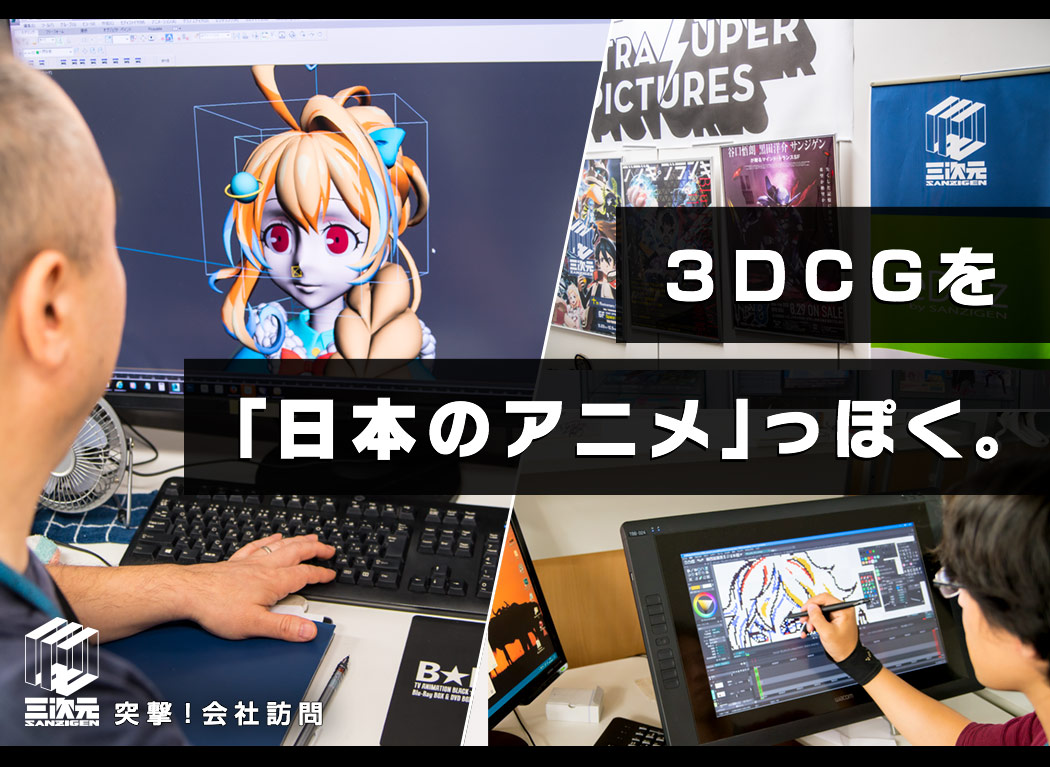
The diffusion of 3DCG animation technology might solve the problems of the Japanese animation industry?
What pops into your mind when you hear about 3DCG animation?
Maybe Japanese people are more familiar with the classic Japanese style of animation (cel animation). 3DCG animation is broadly used overseas, and you can see examples of it in Pixar movies. In Japan, it's sometimes used for battle scenes in mecha anime and for idol transformations.
Although I'm kind of embarrassed to admit this, I don't know much about the evolution of 3DCG animation. But just by taking a look at the dance scenes in PreCure, I can say that computer-created graphics nowadays are amazingly smooth.
Japanese cel anime are mostly 2D and are created by drawing several frames and by moving them to create a movie, as you would do with a flip book. Up until now, it hasn't been uncommon for animators to incorporate CG elements in the face and body of the characters. However, recently, it seems that an increasing number of anime and characters is created in CG - resulting in 3DCG anime that still look like they were hand-drawn. One example is the popular Kemono Friends, one of this year's biggest anime hits.
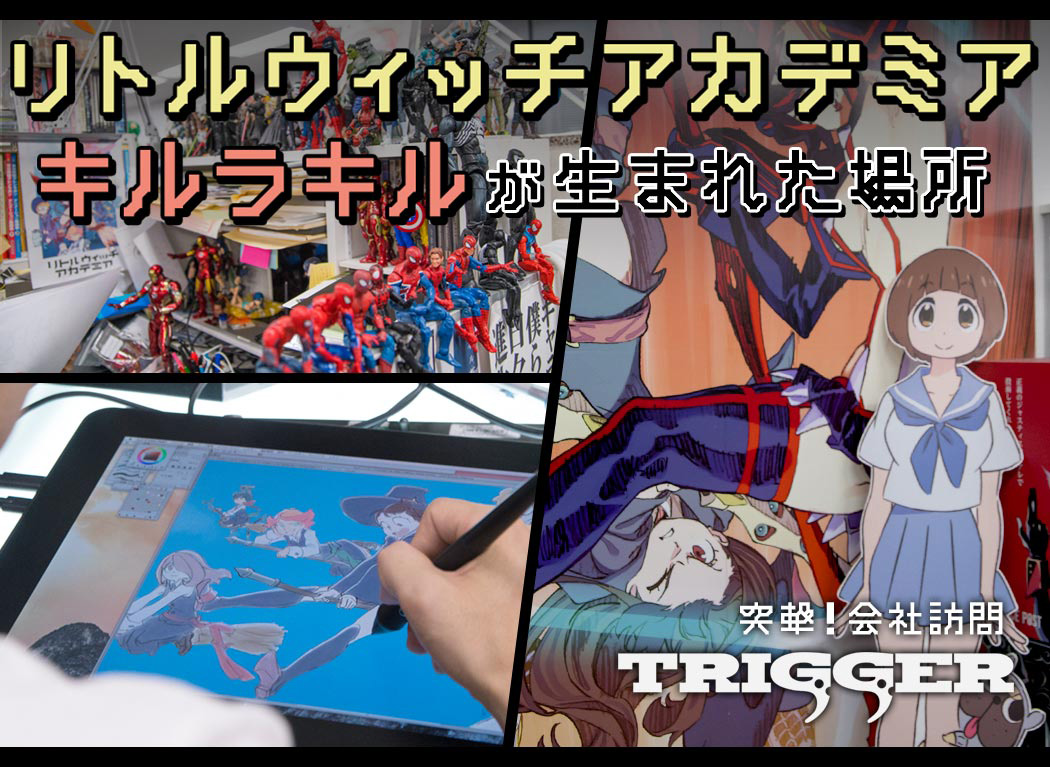
Do you remember our visit to Studio Trigger, in the last issue of Attack!!CompanyVisit? It was the Studio Trigger team who suggested which company I should visit next: it's called Sanzigen, and it's one of the most important when it comes to 3DCG animation. One of their titles, which was created completely in 3DCG animation but which still preserves an hand-drawn feel, is Arpeggio of Blue Steel - Ars Nova.
Why does contemporary 3D graphics look so natural!?
Thank you very much. It's thanks to a technology called "cel-shading" that we can make 3D works look like authentic Japanese cel anime.
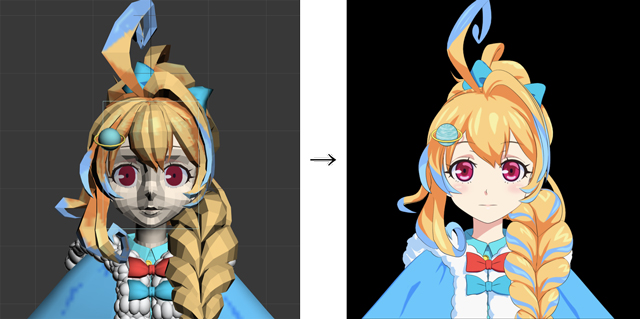
However, although I said that the placement of the various parts is important, sometimes we need to disintegrate a character in order to come up with a good animation.
Well, for example, take this expression (left picture). It's a very natural pose for an anime, but if you take the front view of the same character you get something completely different and unnatural (right picture).
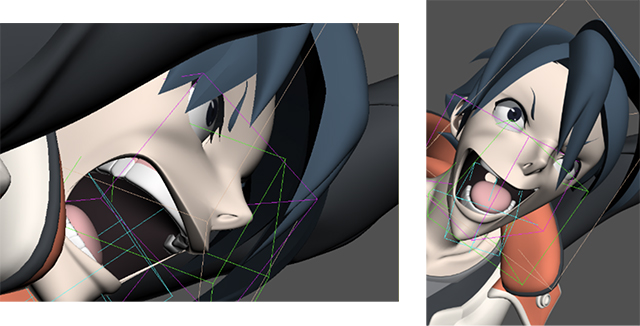
Exactly. A mouth can't open that wide in real life! (laughs)
One of the weapons of 3DCG is having a 3D model that can be moved from every angle. However, this also means that sometimes it's impossible to create animations that would go well with cel anime. For this reason, sometimes we just need to throw away that weapon and pursue the cel style in other ways.
A live-action shooting!? How 3DCG animations are made
You can take a look at the general production flow in this picture (↓). The process itself is close to a live-action shooting and includes camera tests and storyboards.
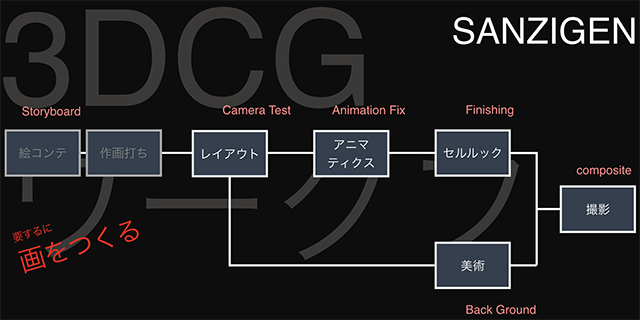
Basically, yes! (laughs)
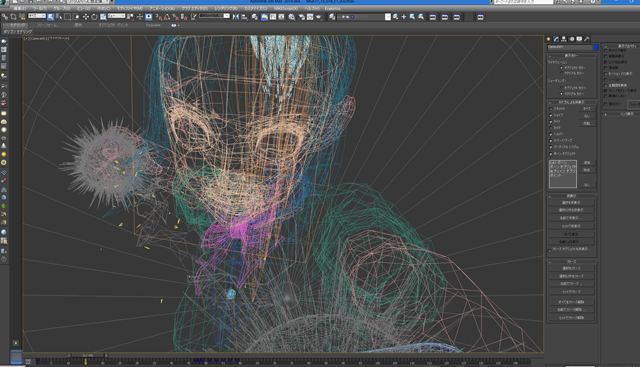
After building a model, we perform a task called rigging, and we establish where the girl’s joints are, how the
clothes are moving etc. Once this is finished, we pass it to the animator,
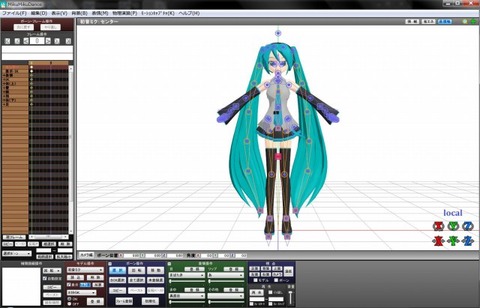
and the animator moves the character just like in MMD.
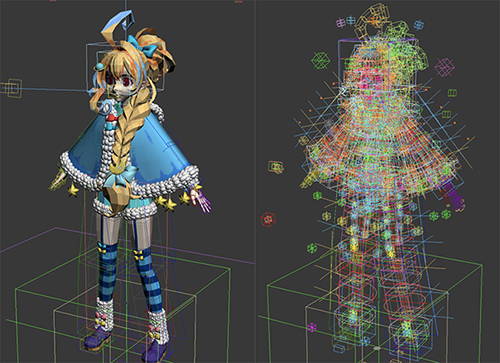
empty doll. (Right) Screen during rigging. At this stage, joints and clothes
decorations are added.
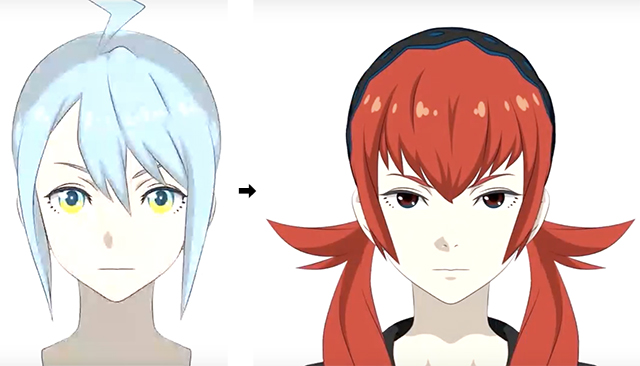
Merging beautiful girls to create more beautiful girls?
There’s no limit when it comes to the pursuit of beautiful girly faces! (laughs)
I don’t have many tricks to share; most of them come from experience.
Since 3DCG is data, it’s now possible to efficiently create high-quality models that reproduce “cute Japanese anime faces” by combining past assets.
Uetaka:
It’s a process of trial and error that involves putting together different parts to create a completely new model.
Since anime should always be cute, it makes sense not to create each new model from zero – but to use and customize hair and eyes we’ve created in the past.Exactly. “Recycling” models is something that can hardly be done in 2D animation. The know-how packed in the hand-drawn original illustrations is something that belongs to the artist, so it wouldn’t be fair to share it with others. Meanwhile, the more 3DCG graphics you create, the more experience, technology and data can be accumulated.
Here’s an example of body parts that have been re-used. Reoko Banryuu from BBK/BRNK was created by using the face from Ultra Super Sisters’ Supica as a base. Yuusuke Kozaki is responsible for the character design of both characters, so we created a model and adjusted it according to the character design.
©ULTRA SUPER PICTURES
©GOOD SMILE COMPANY
The uniform itself was based on a sailor uniform we created in the past – we just had to adjust its length and the design on the skirt. It saves so much time!
Can 3DCG solve the problems of the Japanese anime industry?
Hmmm. Basically, 3D anime are produced not only between members of the production company, but also require a cooperation with others (artists etc). On the other hand, 3DCG animation can be produced by a single company. It’s quite a big difference.
Uetaka:
Exactly. And as I said earlier, we can also use some assets we built in the past… We can recycle various materials, such as birds, tanks and tires.
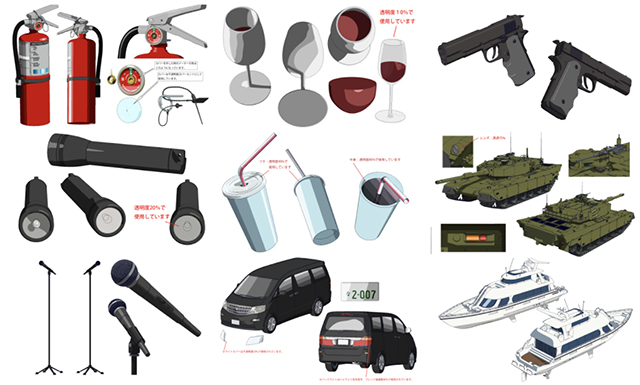
▲ Sharing and using the assets made in the past such as tanks and airframes will make the work more efficient.
Uetaka:
It is! While a TV anime usually takes up to 100 artists to be created, if you’re working with computer graphics it takes just about 20.
If you manage to lower the personnel costs, you can increase salaries. In 3DCG, a single person is responsible for multiple tasks and this means wages are also higher.
Uetaka:
Yes. I think paying employees a sufficient salary is important in order to keep the level of the industry high as a whole.
CG is something that can be used in many different industries. Naturally, if the game world turned out to be more lucrative than the anime world, there would be no reason for skilled people and professionals to stay in the one that pays less. This would take many talented creators away from the anime world, and the quality of the productions would decrease. Therefore, being able to pay creators a good salary is a way to make sure that people stay in the anime industry, and a way to protect it.
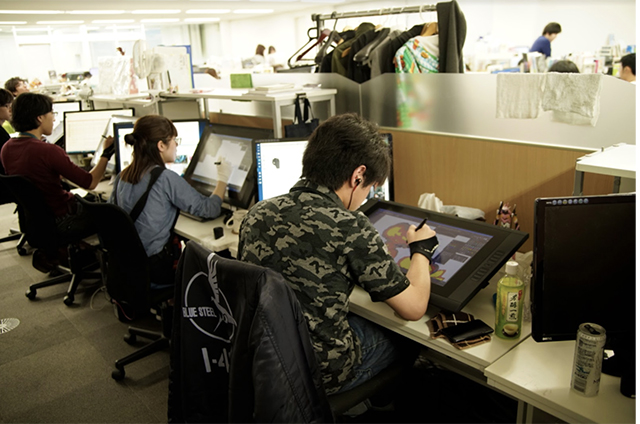
CG's "uncanny valley" was crossed by "Arpeggio of Blue Steel - Ars Nova"
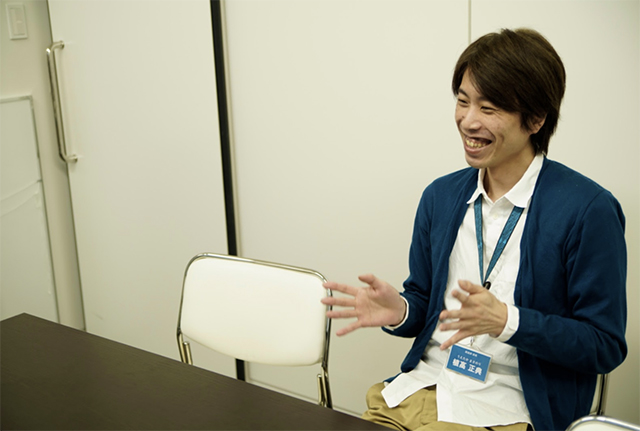
The turning point was definitely Arpeggio of Blue Steel - Ars Nova.
Before it came out, works created using 3DCG were often criticized for not being able to express characters meaningfully, and since viewers weren't familiar with the 3DCG approach, graphics tended to look funny to them. Viewers had this kind of filter that prevented them from enjoying 3DCG; I had a hard time trying to express myself properly.
Uetaka:
Exactly. I was confident that I could create a high-quality animation while making use of 3DCG, and I realized that the viewers were reacting to it differently. Reactions on Twitter went from "3D is scary, unnatural", to proper comments regarding the contents of the anime. (laughs) Finally, I felt like I could deliver what I wanted to express through my works.
And a certain experience regarding the creation of characters in 3DCG was very important to me.
Iona, the protagonist of Arpeggio of Blue Steel - Ars Nova, is a character that goes from being an inorganic robot to acquiring more and more human features as the story goes on. At the same time, her appearance also becomes more natural. That's because the quality of Iona's drawing assets increased as the work progressed - which is something that doesn't happen with 2D animation. It's a feature that is unique to 3DCG.

We'd like to keep creating animations to please the public, and of course, we'd also like expanding further with some satellite office. It would be great to bring animation studios to rural areas, to break the platitude according to which "anime = Tokyo".
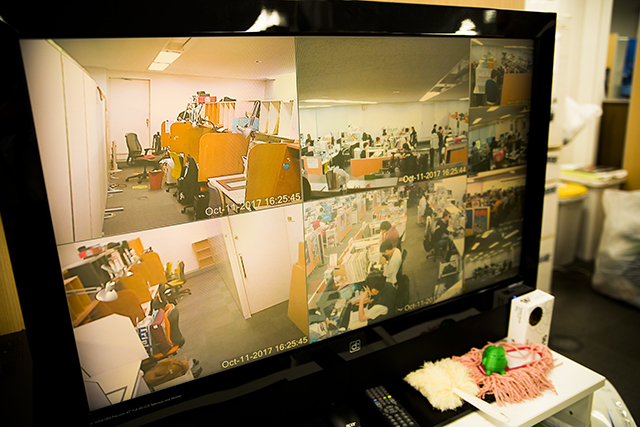
In this office, hope and future are tied together towards a new kind of animation production!
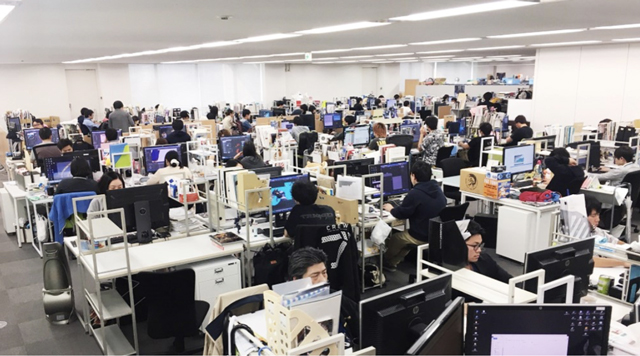
Uetaka told us about how accumulating technology and know-how means improving the quality of 3DCG. While leaving aside the unique culture of Japanese cel animation, this new efficient approach to anime might help to create a better world both for creators and for viewers.
![[Artist’s Spotlight] An interview with designer and illustrator John Kafka - Where traditional painting meets contemporary fashion](https://i.pximg.net/imgaz/upload/20260810/573420973.jpg)

Storyboard: the animation blueprint.
Camera Test: a process used to determine the characters acting, the relation between the position of various elements, the direction of the camera and so on.Animation Fix: the process according to which the flow of the animation is decided.
Finishing: the process of adding shades to the polygon model in order to make it look 2D.